Quick Summary: Most tree service businesses focus on their Local Services Ads budget, cost per lead, and how many leads Google is sending them.
Those numbers matter. But there’s another critical part of LSA performance that’s easy to overlook:
➡️ What happens when the lead actually comes in.
Google includes responsiveness when determining LSA rankings and specifically notes that missed calls can negatively affect responsiveness.
Google also recommends responding to leads as quickly as possible.
When we looked at our own data across thousands of LSA calls from tree care companies, we saw exactly why this matters.
Why Your Response to LSA Leads Matters
Getting More LSA Leads Does NOT Help if the Calls Aren’t Being Answered
When someone searches for tree removal, pruning, stump grinding, or another tree service and calls you through the Local Services Ads platform, they’re often ready to speak with someone right then and there.
They may also be contacting more than one tree service company.
If their first call goes unanswered, they do not necessarily wait for a callback. They often simply move on to the next company they see on Google.
That means there are really two parts to LSA performance:
Getting Google to generate the lead.
Making sure your business captures that lead once it arrives and turns it into booked work.
Increasing your LSA budget primarily helps with getting more LSA leads sent to your business.
It does not automatically mean you’ll book more work.
Google itself lists responsiveness as one of the factors that can influence Local Services Ads ranking and says that missed calls may negatively affect responsiveness.
What Our Own Tree Care LSA Data Shows
We recently analyzed 6,922 LSA leads across 20 tree care companies in our own client data between June 1 and September 2, 2026. Here’s what we found:
6,922 total LSA leads were received
5,776 calls (83.5%)
1,136 text messages (16.4%)
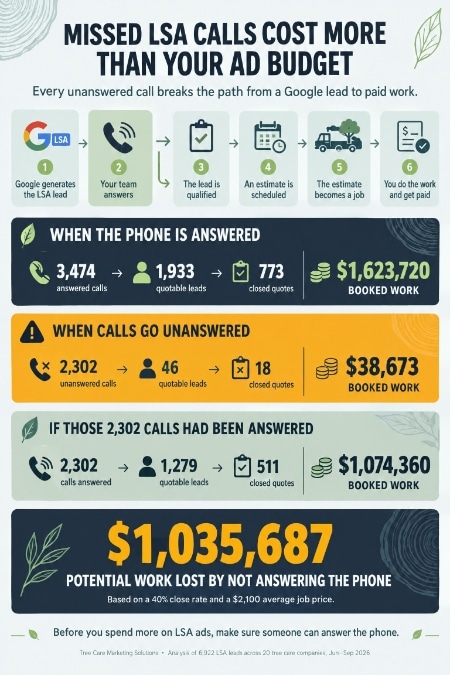
Only 3,474 calls were answered. That’s just 60.1% of phone calls from LSA leads – leads you’ve paid for and who are generally ready to move forward with tree work.
But the more interesting number is what happened to those calls afterward.
1,933 of answered LSA calls were quotable (55.6%)
1,222 of answered LSA calls were not quotable (35.2%)
450 of answered calls required more detail before make a quotable determination (13%)
62 were spam (1.8%)
Among the LSA calls that were answered, approximately 56% were ultimately identified as quotable opportunities. That means they scheduled a quote for a service the client provided and were in the client’s service area.
Among calls that were not successfully answered or connected on the first attempt, only about 2% were eventually identified as quotable.
That’s a huge difference.
It does not mean answering the phone magically makes a bad lead good.
It means that when a potential customer actually reaches someone they can talk with, your team has a much better opportunity to qualify the work, schedule an assessment, and move that lead forward.
The Dollar Impact of Not Answering LSA Calls
Assume an average close rate of 40% for quotable LSA leads and an average job price of $2,100. Our data clearly shows the enormous lost revenue potential from not answering calls from the LSA platform.
Failing to answer the phone when LSA leads called resulted in $1,035,687 in lost work over 3 months.
Higher Answer Rates Mean More Opportunities Stay Alive
We also compared companies based on how consistently they answered their LSA calls.
Tree care companies in our dataset with an answer rate of 90% or higher had an overall quotable-lead rate of approximately 56.5%.
Companies answering fewer than 90% of their LSA calls had an overall quotable-lead rate of approximately 37.6%.
There is an important detail here.
When we looked only at calls that were successfully answered, the percentage that became quotable was almost identical between the two groups.
In other words:
The companies answering more calls did not necessarily receive better leads. They simply gave more of their existing leads a chance to become booked jobs.
That distinction matters.
➡️ Before spending more money to generate additional leads, make sure you’re fully capturing the ones you already have.
Think About What That Means for Your Budget
Imagine your company receives 100 LSA phone calls.
If you answer 90 of them, 10 potential customers never successfully reach someone.
Based on what we’re seeing across our own tree care accounts, a meaningful percentage of the calls that do connect have the potential to become quotable work.
So before increasing your LSA budget to generate another 10 or 20 leads, improving your answer rate may help you capture more value from the leads you are already paying for.
That is one reason we do not look at LSA performance strictly through the lens of:
Monthly budget
Lead count
Cost per lead
We also look at what happens after the lead arrives.
What You Should Do
Make It Easy for LSA Customers to Reach You
There are several simple things tree service companies can do to improve the odds of turning an LSA inquiry into an actual opportunity:
Answer LSA calls as quickly as possible during business hours
Return missed calls promptly
Make sure someone is clearly responsible for incoming leads
Keep automated phone greetings short (you’ll soon be charged for any call over 20 seconds, even if the caller only listened to your phone greeting!)
Avoid complicated phone menus and unnecessary routing
Make sure calls are forwarded to someone who can actually answer questions and book estimates
Keep your LSA business hours aligned with real phone coverage – if you’re not answering the phone 24/7, don’t set your hours to 24/7!
Monitor voicemail regularly
Respond quickly to message leads if messaging is enabled – waiting even 5 minutes is too long
Review whether message leads make sense if your team cannot consistently monitor them
A potential customer should not have to work hard to give you their business!
Set Realistic Business Hours on LSA
Another common mistake is allowing LSA to generate demand during hours when nobody is realistically available to handle it.
Google allows businesses to control when Local Services Ads run.
That means your advertising schedule should reflect your actual operation.
If nobody answers the phone at 7 pm, generating more calls at 7 pm will not help you.
And if your consulting arborists or crews are already booked several weeks out, maximizing lead volume may not make sense at all.
Sometimes good LSA management means increasing spend.
Sometimes it means reducing it.
The goal is not to spend the maximum amount Google allows.
The goal is to generate the right amount of profitable demand for the capacity your business actually has.
Return Message Leads Quickly
If message leads are enabled, response time matters there as well.
Google may display an estimated response time on your LSA profile based on how quickly your company normally replies to messages.
That means potential customers may be able to see whether your business typically responds within minutes, hours, or longer before choosing who to contact.
If your office can monitor messages consistently, messages can be a useful way for customers to reach you.
If messages regularly sit unanswered, however, adding another lead channel can create administrative work without necessarily creating more booked jobs.
This is why we recommend looking at the actual performance of phone and message leads separately rather than assuming more lead types are always better.
More LSA Leads Aren’t Always Better
A successful LSA campaign should not simply produce the highest number of calls or messages possible.
It should produce opportunities that turn into profitable work.
That means looking beyond total lead volume and asking:
How many LSA calls were actually answered?
How many were qualified leads?
How many became estimates?
How many estimates became jobs?
Which services generate the best opportunities?
Which locations perform best?
Do phone leads outperform message leads?
How many paid leads never progress beyond the initial inquiry?
How much revenue ultimately comes from LSA?
A campaign producing 50 well-handled leads can be more valuable than one producing 100 calls that your team does not have the capacity to manage.
Budget, Response Rate & Response Time Need to Work Together
LSA works best when the advertising strategy and the operational side of the business support each other.
The process should look like this:
Google generates the LSA lead → Your team answers → The lead is qualified → An estimate is scheduled → The estimate becomes a job → You do the work and get paid
At Tree Care Marketing Solutions, that’s why we look beyond simply adjusting LSA budgets.
These are just some of the things we review for every LSA account:
LSA lead quality
phone and message performance
service area
business hours
location performance
budget levels
What we’re looking at are the factors that determine whether the opportunities Google generates actually have a chance to become revenue for your business. Because if there’s very little chance of turning an LSA lead into paid work, why are you even running Local Services Ads?
About the Author
Panajota Gushkova
Panajota (Pani) Gushkova is the Paid Search Lead at Tree Care Marketing Solutions, specializing in Google Ads and Local Services Ads for tree care companies nationwide. She focuses on building high-performing, cost-efficient campaigns that consistently generate quality leads for service-based businesses.